

Key Takeaways
Brown-Adson forceps are general-purpose tissue forceps designed to provide a secure grip across a broader contact area than a conventional 1-by-2 tooth pattern.
The model available from Black & Black Surgical measures 4¾ inches, or 12 centimeters, and is manufactured from stainless steel.
Fine Brown-type teeth are designed to engage delicate tissue while distributing gripping pressure across multiple small contact points.
The instrument is available with either a straight or angled tip, giving surgical teams options for different approaches and working angles.
The manufacturer identifies skin, tissue, mucosa, and cartilage among the materials the instrument may be used to handle. Listed applications include blepharoplasty, facelift, and rhinoplasty procedures.
Proper selection should consider the intended procedure, tissue characteristics, preferred tip shape, instrument condition, and the surgeon’s training and technique.
Reusable surgical forceps must be cleaned, inspected, packaged, sterilized, stored, and handled according to the manufacturer’s current instructions and the healthcare facility’s validated procedures.
What Distinguishes Brown-Adson Forceps?
Understanding the Teeth, Handle, and Tip Design
Brown-Adson forceps belong to the broader category of thumb forceps used for grasping and positioning tissue. They are operated by applying pressure to the handle, which brings the opposing tips together.
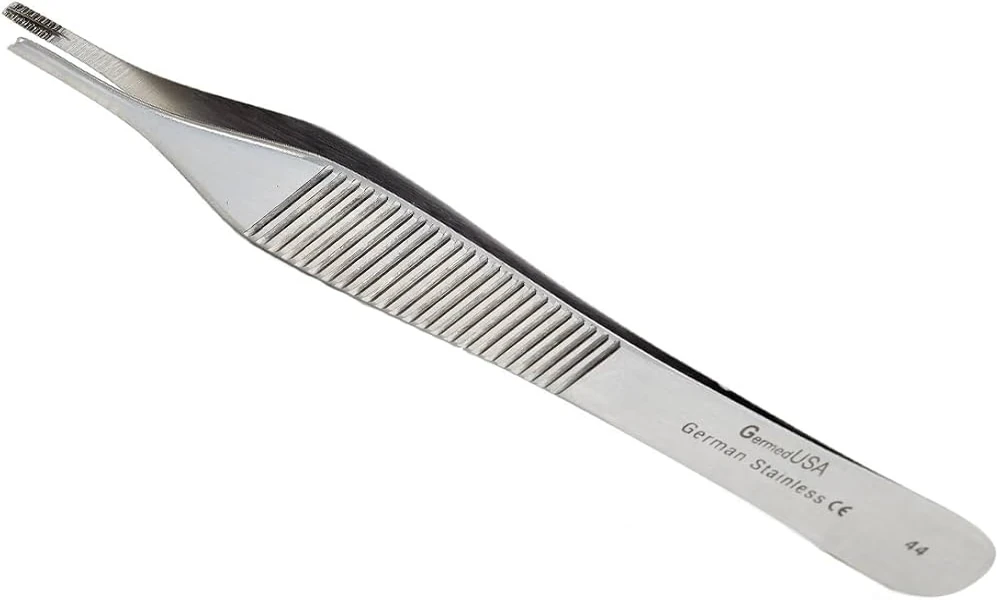
The defining feature is the pattern of fine Brown-type teeth. Instead of relying on one larger tooth entering a corresponding space, the instrument uses multiple small teeth to create a wider gripping surface. This configuration can help distribute contact across the tissue being held.
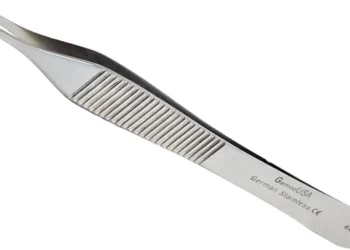
The Brown-Adson model from Black & Black Surgical has an Adson-style handle intended to support control during use. Its working length is 4¾ inches, or 12 centimeters, which provides a compact instrument for procedures involving relatively small operative areas.
Clinical teams searching for brown adson forceps can choose between straight and angled tip configurations. The appropriate option depends on the surgical approach, access to the operative field, and the user’s preference.
A straight tip follows the same general line as the instrument’s handle. It may be appropriate when the tissue can be approached directly. An angled tip can provide a different line of access when surrounding anatomy or the position of the incision makes a straight approach less convenient.
Neither configuration is automatically suitable for every procedure. The surgeon and clinical team should select the instrument according to the planned use and applicable facility protocols.
Applications Identified by the Manufacturer
Black & Black Surgical describes its Brown-Adson forceps as a general-purpose instrument for handling delicate tissue. The product page specifically identifies skin, tissue, mucosa, and cartilage as possible applications.
The manufacturer also lists procedures such as:
- Blepharoplasty
- Facelift surgery
- Rhinoplasty
These procedures may involve tissue that requires controlled positioning during dissection, approximation, suturing, or other surgical steps. The multiple fine teeth are intended to provide secure engagement across a larger contact area than a standard 1-by-2 toothed forceps.
The instrument’s presence on a tray does not determine how it should be used. The clinician must consider tissue condition, anatomy, procedure type, desired grip, and the possibility of tissue injury.
Brown-Adson forceps should not be described as universally atraumatic. Any toothed forceps can damage tissue when used with excessive pressure, applied incorrectly, or selected for tissue that is too fragile for the tooth pattern.
The original article associated this product with cardiac, orthopedic, pediatric, laparoscopic, and endoscopic procedures. Those applications are not listed on the referenced product page. A facility considering the instrument for another application should confirm suitability through the manufacturer’s instructions, professional judgment, and its established clinical procedures.
Selecting and Using the Instrument Responsibly
Matching the Tip Configuration to the Procedure
Instrument selection begins before the procedure. Surgical teams should determine whether the forceps’ length, tip shape, tooth pattern, and handle are appropriate for the operative site and planned technique.
The choice between a straight and angled tip may depend on:
- The direction from which tissue will be approached
- The depth and size of the operative field
- The location of surrounding structures
- The user’s visibility
- Other instruments that will occupy the field
- The steps in which the forceps will be used
- The surgeon’s training and preference
The instrument should be examined before it is added to a sterile field. The tips should meet as intended, and the teeth should appear properly aligned. The handle should move smoothly without unexpected resistance.
A forceps with bent tips, damaged teeth, visible corrosion, cracks, rough surfaces, or poor alignment should be removed from service and evaluated under the facility’s instrument-management policy. Continuing to use a damaged instrument could compromise its grip or increase the possibility of unintended tissue contact.
The forceps should also be distinguished from instruments with similar handles but different tips. Adson dressing forceps, Adson tissue forceps with 1-by-2 teeth, and Brown-Adson forceps are not interchangeable in every situation.
Clear tray lists and instrument descriptions can help staff select the intended model. Photographs, item numbers, and tip descriptions may also be useful when similar instruments are stored together.
Supporting Controlled Tissue Handling
Safe instrument use depends on training, judgment, visibility, and familiarity with the operative technique. General descriptions cannot replace clinical education or procedure-specific instruction.
During use, the operator should apply only the pressure needed to achieve the intended grip. Greater force does not always improve control. Excessive compression can mark, crush, or otherwise damage tissue.
The instrument should engage only the intended tissue. Proper lighting, exposure, and positioning help the clinician see the tips and nearby structures. If visibility becomes limited, the user may need to release and reposition the forceps.
The forceps should not be used for a task that could bend, dull, or misalign the tips. It should also not be used as a clamp, retractor, needle holder, or substitute for an instrument designed for another purpose.
Efficient use in the operating room depends partly on preparation. Before the procedure, the team can:
- Verify the requested forceps and tip shape
- Inspect the instrument for damage
- Confirm that reprocessing documentation is complete
- Place the instrument in its assigned tray location
- Make suitable alternatives available when required
- Review any unusual surgeon preferences
- Confirm how contaminated instruments will be contained after use
During the procedure, neutral-zone or other approved transfer practices may be appropriate when instruments could create an exposure risk. The facility’s bloodborne-pathogen and sharps-handling procedures should guide instrument passing and containment.
Material, Finish, and Reprocessing Considerations
Stainless-Steel Construction and Matte Finish
Black & Black Surgical identifies stainless steel as the material used for this Brown-Adson forceps. Stainless steel is commonly used for reusable surgical instruments because it can provide strength, corrosion resistance, and compatibility with validated reprocessing methods.
Stainless steel is not immune to damage. Exposure to incompatible chemicals, improper cleaning, retained moisture, saline, organic debris, or unsuitable storage conditions can contribute to staining, pitting, or corrosion.
The product also has a nonreflective matte finish. A matte surface can help limit bright reflections from operating-room lighting. The finish does not eliminate the need for careful inspection or proper handling.
The product’s Adson handle is intended to support comfort and control. However, comfort is subjective and may differ among users. Hand size, grip, procedure duration, glove fit, and technique can all affect how an instrument feels.
Claims that the design will prevent fatigue or improve patient outcomes should be avoided. The handle and compact length are product characteristics, but the clinical result depends on many factors beyond the instrument itself.
Before purchasing, a healthcare facility may want to assess:
- The required tip configuration
- Compatibility with existing instrument sets
- Surgeon preferences
- Reprocessing requirements
- Repair and replacement procedures
- Product identification and traceability
- Storage and tray capacity
- Staff familiarity with the instrument
The listed product weight is 0.2 pounds. Buyers should confirm whether listed weights relate to the individual instrument, packaged product, or shipping information when weight is important to purchasing or tray planning.
Cleaning, Inspection, and Sterilization
Brown-Adson forceps are reusable instruments and require complete reprocessing between uses. Reprocessing is a multistep process that includes cleaning and, according to the device’s use and instructions, sterilization.
Personnel should follow Black & Black Surgical’s current reprocessing instructions, the healthcare facility’s validated procedures, applicable regulations, and the instructions for any equipment or chemicals used.
A general reprocessing workflow may involve:
- Safe containment and transport after use
- Point-of-use treatment when specified
- Cleaning with compatible methods and products
- Thorough rinsing when required
- Drying
- Visual and functional inspection
- Packaging
- Sterilization using a validated cycle
- Storage that protects package integrity
- Documentation under the facility’s quality system
The manufacturer’s instructions should determine the exact procedure. Staff should not substitute an unvalidated chemical, concentration, exposure period, cleaning method, or sterilization cycle.
Fine teeth require particular attention during cleaning and inspection because biological material can remain around small surface features. Adequate lighting and magnification may help personnel examine the working end.
Inspection should evaluate:
- Cleanliness
- Tip alignment
- Tooth condition
- Smooth handle movement
- Surface staining or corrosion
- Cracks or deformation
- Legibility of identifying marks
- Overall function
An instrument that remains soiled after cleaning should not proceed as though it were ready for use. It should be returned for further processing according to facility procedure.
Facilities should also protect employees who handle contaminated instruments. Appropriate containment, personal protective equipment, work practices, and bloodborne-pathogen controls are essential during transport and decontamination.
Purchasing and Managing Brown-Adson Forceps
Confirming Product Specifications Before Ordering
Similar instrument names can refer to products with different dimensions, tooth patterns, finishes, materials, and tip shapes. Buyers should review the full product description instead of relying solely on the name “Brown-Adson.”
The Black & Black Surgical product has the following listed characteristics:
- Product type: Brown-Adson forceps
- Length: 4¾ inches, or 12 centimeters
- Material: Stainless steel
- Teeth: Fine Brown-type teeth
- Handle: Adson style
- Finish: Nonreflective matte
- Tip options: Straight or angled
- General purpose: Handling delicate tissue
- Listed materials handled: Skin, tissue, mucosa, and cartilage
- Listed procedures: Blepharoplasty, facelift, and rhinoplasty
The webpage should be checked at the time of ordering because specifications, availability, documentation, and ordering options may change.
Purchasing teams may also need to confirm the catalog number, packaging quantity, country-specific documentation, warranty information, repair availability, and applicable regulatory details directly with the supplier.
The product’s intended use should be compared with the facility’s clinical requirements. A product description can support purchasing research, but it does not replace the clinical review performed by qualified professionals.
Inventory Control, Training, and Instrument Life
Reusable instruments require management throughout their service life. Purchasing the correct model is only the first step.
Facilities should maintain a system for receiving, identifying, inspecting, reprocessing, storing, issuing, and removing instruments from service. The system may include item numbers, tray assignments, maintenance records, repair histories, and replacement criteria.
Staff who assemble trays should be able to distinguish Brown-Adson forceps from similar Adson instruments. Training may cover:
- Recognizing the Brown-type tooth pattern
- Differentiating straight and angled tips
- Checking tooth alignment
- Identifying corrosion or physical damage
- Following the manufacturer’s reprocessing instructions
- Placing the instrument correctly in a tray
- Reporting missing or damaged instruments
- Protecting tips during storage and transport
The instrument’s useful life cannot be determined by a universal number of procedures or sterilization cycles. Longevity depends on use, handling, water quality, cleaning chemistry, sterilization processes, maintenance, storage, and physical condition.
A reusable forceps should remain in service only while it is clean, functional, undamaged, and appropriate for its intended use. When the instrument no longer meets those conditions, it should be evaluated, repaired, or replaced according to facility policy.
FAQ
What are Brown-Adson forceps designed to hold?
The manufacturer describes this model as a general-purpose forceps for securely handling delicate skin, tissue, mucosa, and cartilage. The intended clinical use should always be confirmed against the manufacturer’s current documentation and the planned procedure.
Do these forceps have a 7-by-7 tooth configuration?
The referenced product page describes fine Brown-type teeth and multiple small teeth, but it does not specify a 7-by-7 configuration. Buyers should not assume an exact tooth count that the manufacturer has not published.
What is the length of the Black & Black Surgical model?
The listed length is 4¾ inches, or 12 centimeters.
Are straight and angled versions available?
Yes. The product page lists straight and angled tip options. The appropriate configuration depends on the operative approach, tissue, visibility, and clinician preference.
How are Brown-Adson forceps different from 1-by-2 Adson tissue forceps?
Brown-Adson forceps use multiple fine teeth across a broader gripping area. A conventional toothed Adson forceps commonly uses a 1-by-2 pattern. The preferred design depends on the procedure and tissue being handled.
Can Brown-Adson forceps be used in minimally invasive surgery?
The product page does not identify laparoscopic or endoscopic use. Standard Brown-Adson forceps may not have the length or configuration required for procedures performed through access ports. Suitability must be confirmed for the specific procedure and device.
How should the forceps be cleaned and sterilized?
Users should follow Black & Black Surgical’s current reprocessing instructions and the healthcare facility’s validated procedures. General online advice should not replace the instrument’s instructions for use.
When should a Brown-Adson forceps be removed from service?
The instrument should be evaluated when it has damaged or misaligned teeth, bent tips, corrosion, cracks, rough movement, retained soil, or another condition that could affect safe function. Repair or replacement should follow facility policy.
Useful Resources
- Black & Black Surgical Reprocessing Instructions
- Black & Black Surgical
- FDA Reprocessing of Reusable Medical Devices
- FDA Information for Healthcare Facilities
- CDC Disinfection and Sterilization Guideline
- CDC Recommendations for Disinfection and Sterilization
- OSHA Bloodborne Pathogens Standard
- OSHA Central Sterile Supply Guidance
- Association of periOperative Registered Nurses